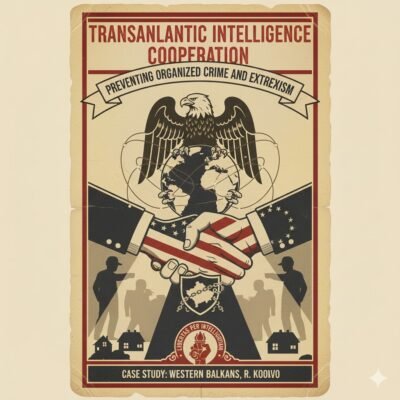
Transatlantic Intelligence Cooperation in Preventing Organized Crime and Extremism: Case Study Western Balkans, R.Kosovo
Prof.Ass.Dr.sc.Mesnut Ademi
P.h.D.c.Drizan Shala
www.askk-ks.com
Abstract
The role and tasks of intelligence services in the Western Balkan countries face complex and multidimensional challenges, among which organized crime, extremism (religious and political) and radicalism constitute major threats to national and regional security. These phenomena often appear in interaction with actors within state and international institutions, increasing the level of risk and making effective detection and prevention difficult. As a result, the fight against these phenomena requires close cooperation between intelligence services in a transatlantic framework, encompassing North America, Europe, the Western Balkans and the Middle East.
Contemporary methodologies of intelligence services, based on open, closed and secret methods, have often not yielded sustainable results in the orientation and preparation of new professional generations. This is related to the wide scope of the activity of criminal and radical groups in several dimensions simultaneously, including the military (armaments), financial and socio-economic (money laundering), educational-doctrinal, as well as spiritual-religious aspects. These groups often operate in symbiosis, mutually supporting each other and exploiting the structural weaknesses of the states in the region.
Drawing on the historical experiences of intelligence services at the global level and early strategic warnings, this study argues for the urgent need for methodological advancement and innovation in the education, treatment and professional development of new intelligence cadres in the Western Balkans. The geostrategic position of the region, and especially of the Republic of Kosovo, as well as the socio-political conditions created in recent years, have favored the activity of criminal, radical and extremist groups. Therefore, a clear and comprehensive understanding of these threats is an essential prerequisite for the establishment of a professional, effective and sustainable intelligence service.
Keywords: Intelligence services; organized crime; radicalism; extremism; methodology.